

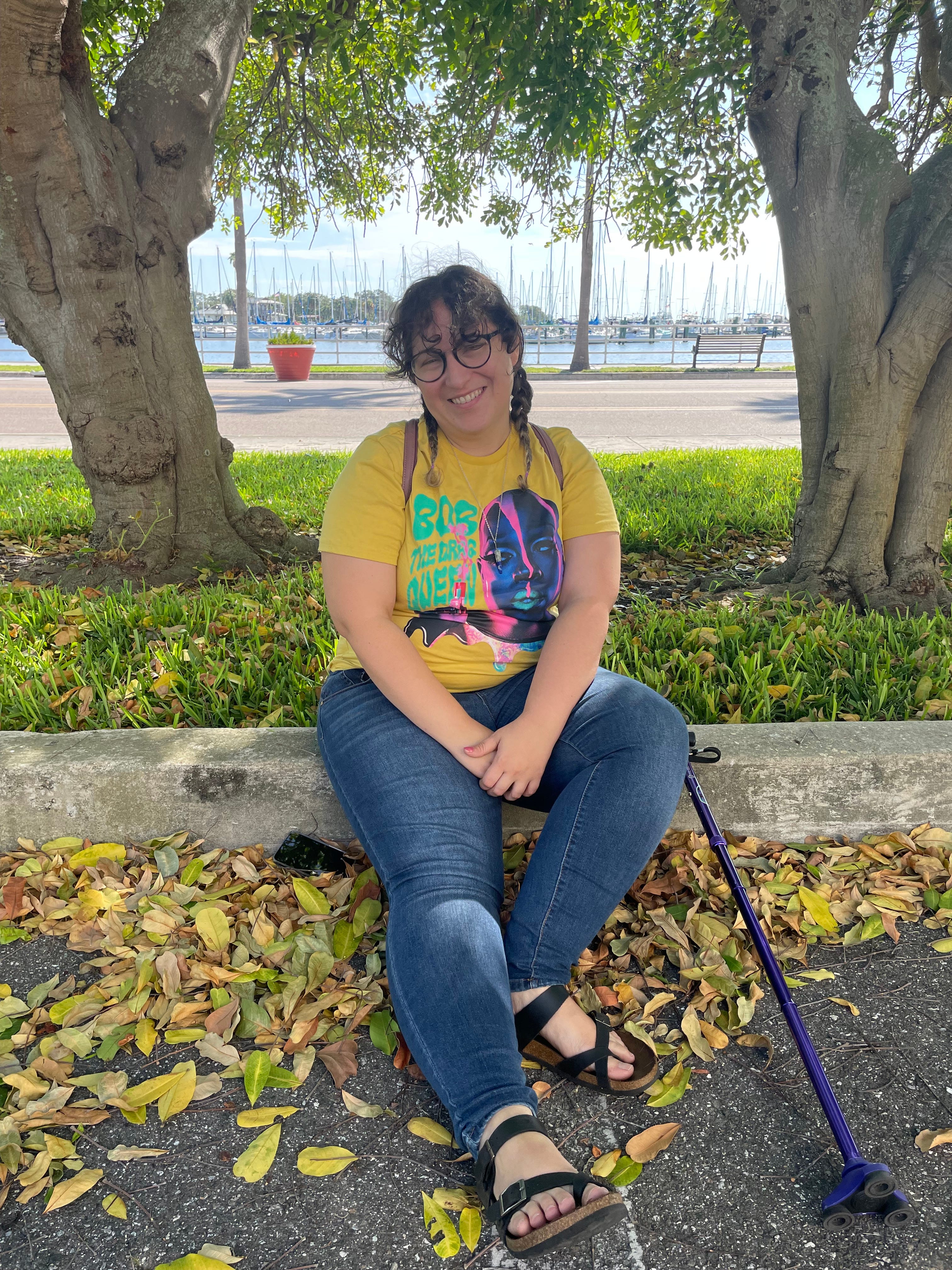
I was on the edge of having everything I thought I ever wanted. I had a six-figure salary at a job I loved, an awesome partner who loved and supported me, and was about to buy my dream house near the beach with help from my loving parents. It seemed like I was actively living the dream, but my body was falling apart. I couldn’t walk without a cane, my body pain was overwhelming, I couldn’t keep food down and I was collapsing with weakness daily, not able to leave the bed or my beloved hammock swing for hours at a time. It had been 4 years since I left a traumatic living situation (aka my abusive marriage) several years prior, but my body didn’t know that. It was screaming at me to listen, and it took a very scary visit to the Mayo Clinic to wake me up to the reality I was facing… my nervous system was fried. And not just burnout fried, I mean permanently dysfunctional. I was suffering with Functional Neurological Disorder, or FND.
I remember pulling up to the Jacksonville Mayo Clinic in 2022 with my then partner and crying in the car as we approached the entrance.
“I am finally going to get answers. I will finally know what is wrong with me and how to treat it. And that’s good, because I can’t live like this any longer.”
They drove me around to the parking lot and I remember everyone being so nice. The parking attendant let us park in a spot not normally allowed, but they weren’t busy, so it wasn’t a problem. Every doorway led to another smiling face happy to help.
“Do you need any assistance?”
“Yes, you need to go down this hall and take the elevator up to that floor.”
“Would you like a wheelchair?”
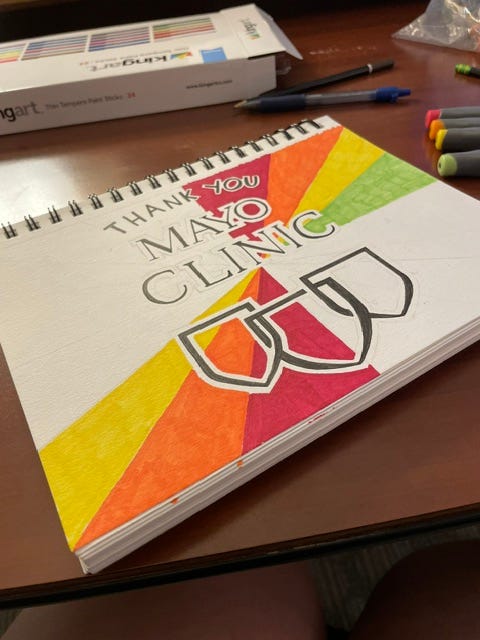
The fact was, I did need a wheelchair. For most of that year I had been using a $19.99 collapsable walking cane from Walgreens that I had named Candy. Candy Cane. It was the kind of humor that made me laugh in the face of what I was actually facing; a future that felt uncertain and scary. Once in the doctor’s office, I felt safe. It was spacious and had wonderfully comfortable chairs and even a separate area for your personal belongings. Because the Mayo Clinic is a specialized hospital, the rooms, the people, all of it was the best I had ever experienced in healthcare. I felt special and loved and like I was important to them.
When the doctor came in, she asked a few very specific questions about my pain and my medical history. We did a diagnostic test where she pushed and pulled on certain parts of my body, noting the difference between each side. She asked me to walk with and without my cane. Then she said, “we could keep going with this exam, but I already know what you have. You have Functional Neurological Disorder.”
Now, I had been researching everything possible to figure out my diagnosis, and I had never heard of this. I was using Dr. Google to ease, or increase, my anxiety over my current neurologist’s lack of answers. I really thought I had MS since all of my symptoms lined up with that diagnosis. I really thought going to the Mayo Clinic would just mean my regular doctor overlooked something that only fancy doctors could see. Turns out, my doctor was just behind the times.
“What is Functional Neurological Disorder? I’ve never heard of that…”
FND is a neurological condition caused not by structural changes in the brain, like you see in Multiple Sclerosis, but by how the brain actually functions. People with FND do not sustain any permanent brain “damage”, even if the symptoms are similar to conditions where that does happen. Instead, people with FND experience symptoms at random and in any part of the body, because the brain is misfiring due to an inability to send and receive signals properly. FND is often diagnosed in patients experiencing debilitating neurological symptoms like seizures, migraines, dizziness, problems speaking or seeing, numbness, fatigue and pain that gets worse with attention and lessened with distraction and typically coincides with a traumatic event or personal history. As she began to describe my own symptoms back to me perfectly, I felt seen, finally. I really do feel like this is the answer. However, there was part of her description that left me confused.
“What do you mean my seizures don’t cause any permanent damage to my brain? How is that even possible?”
Functional seizures, or non-epileptic seizures, are different in that they do not start by electrical changes in the brain. Hence, they are reactionary to dysfunction, not damage. According to the iHealth Directory, “there are several factors that cause a non-epileptic seizure and some of them include severe mental and emotional trauma, migraine, narcolepsy, and other physiological conditions that have an effect on the flow of blood to the brain as well as constant changes in the levels of oxygen and sugar in the brain.”1
Basically, anything that can trigger an extreme reaction in the body can cause a non-epileptic seizure. That would explain why I would lose the ability to move every time I thought about going to the doctor, doing something challenging at work or talked about an emotional trauma, ie. my past abuse. My body could not handle the emotional toll of these events and shut down in an effort to keep me safe. I was actively pushing back against a body that was done trying to find homeostasis. Now, it was just trying to be heard, and in the most dramatic way possible.
“You don’t need your cane anymore. In fact, it is causing significant gait problems that will not go away until you give it up. Using it is making things worse. If you think you’re going to fall over, stand near the wall.” my new neurologist told me.
“Uhh, wait a second, what!?” I thought. “I just told you I fall over all the time I stand up and I can barely walk without extreme pain. Now, you are asking me to take away the one thing giving me some physical freedom. Really?!” I was feeling frustrated that this diagnosis was not something I had researched. I didn’t know what to do to get better.
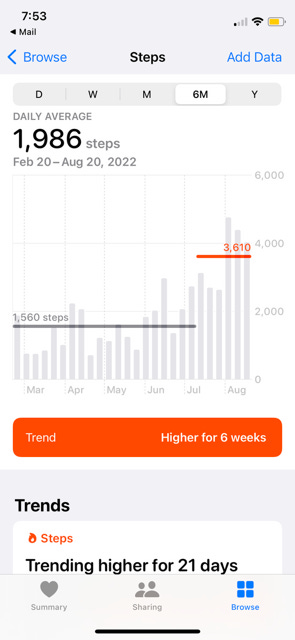
“So, how do I learn to walk without this cane again? Do I just give it up and hope for the best? Is this all just in my head?” I said.
She laughed and assured me the diagnosis is actually quite common, one of the most diagnosed at the Mayo Clinic in fact. She also said there was a way to get better and improve the quality of my life, but it would take time and hard work. I could learn to walk without the cane again and also get lots of help learning to live a full life with some specific reconditioning and a multidisciplinary team of doctors. She then referred me to the Mayo Clinic’s Pain Rehabilitation Center, also known as PRC.
PRC is a 21-day outpatient program at the Mayo Clinic that provides multi-disciplinary support in a small group setting. About 12-15 people create a cohort that learns together about Cognitive Behavioral Therapy, Occupational Therapy, Physical Therapy and Music Therapy, along with many other types of modalities, that increase the well-being and health of each person both collectively and individually. Each day a new person is admitted and one person graduates, so the course is rolling and over the 21 days of attendance, you learn skills to help get you back out into the world without crashing.
I can say with certainty this program changed my life, and I would not be functioning the way I do today without it. I learned valuable life skills, like how to do laundry without hurting my back, how to walk and move with the support of my body and how to navigate physical or mental overwhelm in public. A lot of what I learned was about having and holding boundaries, as most of the people in the course were people pleasers. Go figure!
The program helped me learn to work with my body, recognize signs of oncoming dysfunction, and rework my lifestyle to support my new physical, mental and emotional needs. I no longer viewed my body as the tool for my mind to be productive, I saw my entire being as a unit, working together as one to support my life.
The three main words that now make up my daily mantra are: stable, moderate and flexible. Everything I do now must fit at least one of these categories. I want to go to the grocery store, but it’s a Sunday, it’s raining and I have to take the bus? That sounds like a recipe for disaster. Instead, I now order pantry items online from a website that uses sustainable shipping practices (stable) and offers discounts on brands I like. If I need to, I only go to the grocery store when I have time and there will be a smaller likelihood of overwhelm, like Tuesday mid-morning (flexible and moderate). I also have to be open to how things get done. Often, the hardest chore for me is doing the dishes. Sometimes, I have to wash one or two plates at a time and then rest. Or allow someone else to do them for me, something that takes the control away from me regarding how the dishes get done. Letting go of control is difficult but learning this skill helped grow my trust in other people and learn I don’t always have all the answers. I became more flexible with the expectations I hold for myself and for others and that made room for more. More time, more love, more freedom.
Part of what makes FND so difficult is having to constantly monitor and live within your capacity, taking stock of where your physical, mental and emotional limit is at all times, and then being flexible enough to accommodate whatever it is you need in that moment. This is something your nervous system should be doing for you daily, so taking over these functions for yourself is a full-time job. Disabled people are using all of their energy to stay well and cannot be held to ableist standards of over production and focus on constant improvement. I think no one should be held to ableist standards. In order to stay healthy, or for any other reason.
Asking for help, learning to pace myself and strength training were all helpful skills I learned at the Mayo Clinic as well. I was not good at asking for others to help me. I considered myself very capable and independent before FND and it took a lot of letting go to ask for help of any kind. Now, my friends will tell you I have no difficulty asking for help, but the learning curve was steep, and it was not an inherent skill I had. It took action steps, one of which you can read about here from back in early 2024 when I thought I needed to be hospitalized again, this time for my mental health. Moving across the country was not moderate, stable or flexible… I had to learn those skills again when I arrived in Seattle in 2023. But having the foundation of pacing and strength training gave me a place to start physically and with support from my family and friends, I ended up not needing inpatient treatment that year. Since then, I have relied on several key things that keep my FND in check. They include:
1. Daily Stretching
2. Hydration, Rest and Food (aka - never miss a meal)
3. Trying something before opting out
4. Doing things that I love for a living
Daily Stretching is a game changer for me. I am going through a rough patch right now and I’ve stopped doing my stretches. And I fucking feeeeeeel it. I made this quick guide to the stretches so I didn’t need to use my brain as much to start the process. I just look at the sheet and do what is listed. I’ve done these almost every morning for the last three years, so I know them by heart now and once I start, I automatically finish, which is a plus of doing something so many times - It does get easier. You know what doesn’t though? Building the mental and physical energy to start. So, I now use music as a cue! As soon as I get up, I put on a specific song that makes me want to stretch and BAM, I’ve suddenly started. But if I don’t put on the music… good luck getting me to stretch!
As someone with a history of ED, I can acknowledge that eating is always going to be a struggle. I have multiple food allergies and sensitivities (thanks Endometriosis) and as a neurodivergent person, eating requires specific textures and temperatures in food or beverages for me to consume them. Learning that I had sensory issues with food and that this was common in the neurodivergent world finally allowed me to eat how I wanted to. As long as I did it at all, it was a success. I have realized that I don’t crave a lot of different foods day to day. In fact, I tend to eat the same thing every day, until I get the urge to never eat those foods again, which is another common feeling in the ND crowd! I always have protein bars and electrolytes on hand as I will down those easily when plain water and an apple will take too much willpower. Along with never missing a meal and staying hydrated, even if it’s Boba and a pastry, I must also rest. This is non-negotiable. But rest isn’t just doing nothing, it is active. Rest requires thought. Rest is reading, playing or listening to music, or walking your dog. Rest helps to build you back up, not wind you down into the ground. Living a more intentional and slow life has helped me find more rest. I mend my clothes instead of buying new ones. I hand paint art instead of going on amazon and ordering something. And I like myself and my world more because of it.
Before I can quit, I have to try. This is a huge rule for me, as sometimes a distraction is what I need to move past the way I’m feeling. If I can go to work, sit down and focus on the task at hand, I usually feel better because my thoughts are not focusing on the pain, fatigue or tremors. But sometimes, I start something and it doesn’t do enough to move me past the moment and I have to stop. This can look like calling in to work after attempting to teach a lesson but not being able to hold my body upright. This can also look like me getting up and walking to the coffee shop, only to need help walking home because I can’t move past the seizures that are coming at me. There were a lot of things I would never even try before I went to the Mayo Clinic, but learning to try even if I “failed” helped me realize that yes, sometimes the symptoms are temporary, and I can move forward if I try! But sometimes I just can’t, and that is not a reflection on my desire or ability to do the thing, but where my body and nervous system are at that particular moment.
Figuring out how to earn a living as a disabled person is super challenging. There were a lot of work from home jobs in 2022 when I got my FND diagnosis, but then corporations didn’t like that their employees were enjoying their lives more and working less, so they forced everyone back into the office. This directly affected me and my job at the time as I was a support employee who worked remotely and was told I had to be in a store every day, even though I did most of my job from home or on the road. Eventually, I asked my job for accommodations that my Occupational Therapist at the Mayo Clinic helped me come up with and I was immediately shot down. I didn’t understand it - I was a star employee who had helped the company make a lot of money and build a lot of retail stores. But that didn’t matter because I could no longer be exploited. I was actively asking for what I was worth, and that was my health. I was worth having a life where I wasn’t breaking my back 12 hours a day on my feet or traveling across the state by car every 4 days. And even though loosing that job felt like a stab in the back, it opened up the opportunity to choose myself finally. To say, “Ya know… I don’t think I want to stay in Florida. I think I want to completely change my life, move across the country, and start over again.” And I did just that. The first several years were not easy, I was working two jobs and had no time for myself. But I wrote down what I wanted in a job one day and thought about it often. I kept looking out for opportunities that aligned. Something that brought me and my community joy. Something that allowed me to make my own schedule and work from home. Something with higher wages and less hours. And miraculously, I found it. I have never been happier at a job, and I am endlessly grateful for the opportunity to help trans people find their authentic and affirming speaking and singing voices.
Life with FND is not easy or fun sometimes. But life before FND was just as hard and painful without any answers. Finding a diagnosis made my life better in every way possible. If you know anyone who is struggling with weird, random neurological issues, and all of their scans come back clear, you might want to consider Functional Neurological Disorder. You can find most resources here at FND Hope.
It is currently Functional Neurological Disorder Awareness month! If you feel compelled to support those with FND and help fund future research, consider donating to FND Hope. They do incredible work to support the community!
Non-epileptic seizures | iHealth Directory